
Sari Kenraali, TtM, lehtori, HAMK
Jelena Santalainen, erityisasiantuntija, HAMK
The transition towards more sustainable economies and societies is changing the skills needed in the world of work. Technical and Vocational Education and Training (TVET) helps prepare learners for occupations increasingly shaped by environmental, social and economic sustainability (UNESCO-UNEVOC, 2017). In Finland, sustainable development is defined in vocational education as both transversal and occupation-specific competence (Finnish National Agency for Education, n.d.).
A key challenge is translating broad sustainability goals into the understanding and occupational competences needed in different fields. Research highlights the importance of competencies that enable learners to address complex sustainability challenges across contexts (Demssie et al., 2026; Hammer & Lewis, 2023). Teachers and curriculum developers therefore need practical approaches for turning sustainability objectives into relevant learning outcomes.
The Kenyan TVET Goes Green project (August 2024–June 2026) supported the integration of sustainable development into Kenyan TVET. It brought together Kenyan TVET institutions, national authorities and Finnish experts to develop greener curricula, strengthen teachers’ pedagogical capacity, support institutional change and generate knowledge on sustainable TVET. This article examines the Greening TVET Toolkit, developed through this international RDI collaboration, and considers the changes observed and the factors shaping wider uptake.
From sustainability goals to TVET practice: the Greening TVET Toolkit
Greening TVET requires translating sustainability goals into occupational competences, learning outcomes and teaching practices. The Greening TVET Toolkit provides a practical process for doing so. Rather than treating sustainability as an additional subject, it starts from the occupational tasks and competences learners need to work sustainably. This reflects the view of greening TVET as an institutional and educational process, not simply the addition of sustainability content to curricula (UNESCO-UNEVOC, 2017).
The approach draws on UNESCO’s understanding of Education for Sustainable Development (ESD), which emphasises the knowledge, skills, values and attitudes learners need to contribute to sustainable development (UNESCO, 2017, 2024). The Toolkit operationalises these principles in a competence-based TVET context (Figure 1).
Diagram: Sari Kenraali
Figure 1 The Greening TVET Curriculum Integration Process
The process was first developed through curriculum workshops with three Kenyan TVET institutions: a national polytechnic, a technical college and a vocational college. Each selected one curriculum—welding, civil engineering or automotive engineering—for development. Teachers, students, representatives of public authorities, relevant stakeholders and people from the world of work took part. Their involvement treated sustainability as a shared curriculum-development task, not one for teachers alone.
Participants identified occupational tasks connected to sustainability and reviewed sustainability elements already present in the curriculum (Figure 2). They then identified the knowledge, skills and attitudes needed to perform these tasks sustainably and translated them into competence-based learning outcomes. The initial lists were prioritised, combined and simplified before the outcomes were integrated into existing curriculum structures (Figure 3).
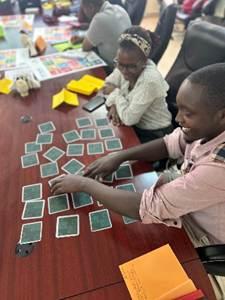
Photo: Sari Kenraali (2025)
Figure 2 Exploring Sustainability Competencies: A TVET Teacher Workshop Session
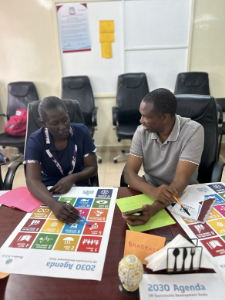
Photo: Sari Kenraali (2025)
Figure 3 Teachers Collaboratively Designing Curriculum Modules during the Workshop
How the workshop outputs could be applied depended on institutional autonomy. The national polytechnic could modify its curriculum directly and adopted the revised curriculum. The technical and vocational colleges followed national curricula and could not make independent changes, so their outputs required national-level processes. The Technical and Vocational Education and Training Curriculum Development, Assessment and Certification Council (TVET CDACC), mandated to design and develop competency-based TVET curricula, participated as a national stakeholder (TVET CDACC, 2023).
Building on the pilots, HAMK worked with TVET CDACC, the State Department for TVET of the Ministry of Education (SDTVET) and the Kenya School of TVET (KSTVET) to develop the Toolkit into an adaptable three-day workshop framework that could support wider use, including at national curriculum level. It was shaped through collaboration and practice rather than designed as a fixed intervention by external partners. A related Action Plan workshop explored dissemination across pilot and non-pilot institutions. The Toolkit workshop also shared the approach with teacher educators and other relevant stakeholders, supporting their understanding of the Toolkit and its potential use.
From curriculum to implementation
Curriculum integration alone does not change teaching practice. The next phase focused on translating sustainability-oriented curricula into teaching, learning and assessment.
Implementation workshops for teachers covered sustainability mindsets and the UN Sustainable Development Goals (SDGs), sustainable development pedagogy, and practical implementation. Drawing on UNESCO resources, teachers explored how pedagogy can help learners develop the knowledge, skills, values and attitudes needed for sustainable action.
On the third day, teachers developed implementation plans using their sustainability-integrated curricula. ABC Learning Design (Young & Perović, 2016) helped them translate learning outcomes into teaching and learning activities. Teachers created visual storyboards of learning sequences, identified where sustainability outcomes would be addressed and considered how learning would be assessed, including through formative assessment (Figure 4).
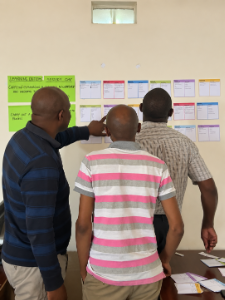
Photo: Sari Kenraali (2025)
Figure 4 Designing Sustainable Study Units Using the ABC Learning Design Method in a Co-Design Workshop
This work highlighted the difference between including sustainability in a curriculum and teaching it in practice. Curriculum development identifies what learners should learn; implementation planning considers how learning experiences can help them develop those competences. Sustainable pedagogy connects curriculum intentions with students’ learning experiences.
What happened beyond the workshops?
Follow-up evaluations found that curriculum greening continued beyond the workshops, although differently across institutions. At the national polytechnic, the revised curriculum had been formally adopted and implementation had begun. At the other institutions, teachers had started integrating sustainability into daily teaching and practical exercises, despite lacking the same authority to approve curriculum changes.
The changes were linked to vocational practice. For example, a revised Welding and Fabrication curriculum includes outcomes on efficient use of welding materials, metal recycling and repurposing scrap metal into functional products. It also covers renewable energy applications, including designing a renewable energy system for a small welding workshop, as well as greenhouse gas emissions and welding’s environmental impacts. Sustainability was thus translated into occupational competences rather than added as an isolated theoretical topic.
Scaling beyond the pilot: implications for international RDI
The different paths taken by the partner institutions highlighted the importance of leadership, mandates and national mechanisms. Where leadership was engaged, activities continued more actively, including further development and independent greening initiatives. The national polytechnic could modify and implement its curriculum, while the other colleges worked within national curriculum structures. Teachers could still integrate sustainability into teaching, but formal curriculum adoption required national mechanisms, including TVET CDACC.
International RDI projects should consider scaling pathways from the outset. Tools intended for wider use need to be co-created with both practitioners and actors authorised to adopt, approve or disseminate them. In this case, TVET CDACC, SDTVET and KSTVET contributed to developing the Toolkit and Action Plan, connecting practical work with national TVET structures and creating a pathway for wider uptake.
Impact should also be assessed beyond immediate project activities. Curriculum changes, teaching practice, institutional adoption and continued use vary across contexts. Local partners should be involved early and continuously as equal co-designers, with time to build shared understanding, adapt the approach and identify ways to use it beyond pilot institutions. Their contextual knowledge helps shape outcomes and challenge assumptions made by external RDI partners.
The Kenyan case shows that international RDI is more likely to support sustainable change when practical tools are co-developed alongside the actors, leadership and structures needed to apply and scale them across the TVET system.
Funders: Financed by Germany and Government of Finland (through the Youth Employment and Vocational Training 2 program), implemented by GIZ (Deutsche Gesellschaft für Internationale Zusammenarbeit)
Generative AI was used as a writing and language support tool during manuscript preparation. The authors are responsible for the content, interpretations, sources and final manuscript.
Demssie, Y. N., Rajala, A. J., & Lehtomäki, E. (2026). Social sustainability competencies: A globally informed reference framework integrating non-Western and Western expert perspectives across all continents. Journal of Cleaner Production, 560, 148370. https://doi.org/10.1016/j.jclepro.2026.148370
Finnish National Agency for Education. (n.d.). Kestävä kehitys ammatillisen koulutuksen tutkinnon perusteissa. https://www.oph.fi/fi/opettajat-ja-kasvattajat/kestava-kehitys-ammatillisen-koulutuksen-tutkinnon-perusteissa
Hammer, T., & Lewis, A. L. (2023). Which competencies should be fostered in education for sustainable development at higher education institutions? Findings from the evaluation of the study programs at the University of Bern, Switzerland. Discover Sustainability, 4, 19. https://doi.org/10.1007/s43621-023-00134-w
TVET CDACC. (2023). TVET CDACC strategic plan 2023–2027.
UNESCO. (2017). Education for sustainable development goals: Learning objectives. UNESCO. https://doi.org/10.54675/CGBA9153
UNESCO. (2024). Greening curriculum guidance: Teaching and learning for climate action. UNESCO. https://doi.org/10.54675/AOOZ1758
UNESCO-UNEVOC. (2017). Greening technical and vocational education and training: A practical guide for institutions. UNESCO-UNEVOC International Centre for Technical and Vocational Education and Training.
Young, C., & Perović, N. (2016). Rapid and creative course design: As easy as ABC? Procedia – Social and Behavioral Sciences, 228, 390–395. https://doi.org/10.1016/j.sbspro.2016.07.058




Vastaa