

Tedros Ghebrebrhan, Master of Engineering
Registered Nurse (Sairaanhoitaja), Pohde, Oulu, Finland
Fragmented information as a systems problem
Electronic records improve access to information, but the increasing amount of information, poor display and excessive alerts can increase cognitive load and contribute to errors (Nijor et al., 2022). Clinical decision support can help, but benefits depend on workflow fit, implementation and continuing evaluation; poorly placed support can add interruption, automation bias or alert fatigue (Sutton et al., 2020). Therefore, the design target should be the work system, not a single algorithm.
This is a sociotechnical problem. Patient safety emerges from interactions among people, tasks, technology, organisational conditions and the care environment (Carayon et al., 2006; Sittig & Singh, 2010). Government policy and institutional rules shape staffing, documentation and escalation responsibilities (Sittig & Singh, 2010). From this perspective, systems intelligence adds a useful human perspective: people must perceive, understand and act within a system of which they are already part (Hämäläinen & Saarinen, 2008). For NEO, intelligence means making the next safe action and its dependencies visible without removing professional judgement.
How NEO Connects the Clinical Workflow
NEO’s prototype is organised around a proposed workflow layer that complements rather than replaces an EHR. A patient list supports prioritised review; observations and trends lead to an ABCDE-supported assessment; a Critical Event workspace connects escalation, role clarity and time-stamped actions; ISBAR structures communication; FinCC 4.0-oriented previews connect care needs, interventions and outcomes; and follow-up tasks carry responsibility into reassessment and the next shift.
These elements are intentionally linked. ISBAR can improve the completeness and quality of handovers, although evidence for patient outcomes remains context-dependent (Müller et al., 2018). Alongside this, FinCC 4.0 offers a national structure for documenting nursing diagnoses, interventions and outcomes and for supporting continuity when care responsibility changes (Kinnunen et al., 2025). In NEO, neither structure is treated as a form to complete after the event. Communication, documentation and follow-up are designed as connected parts of the same clinical reasoning trail.
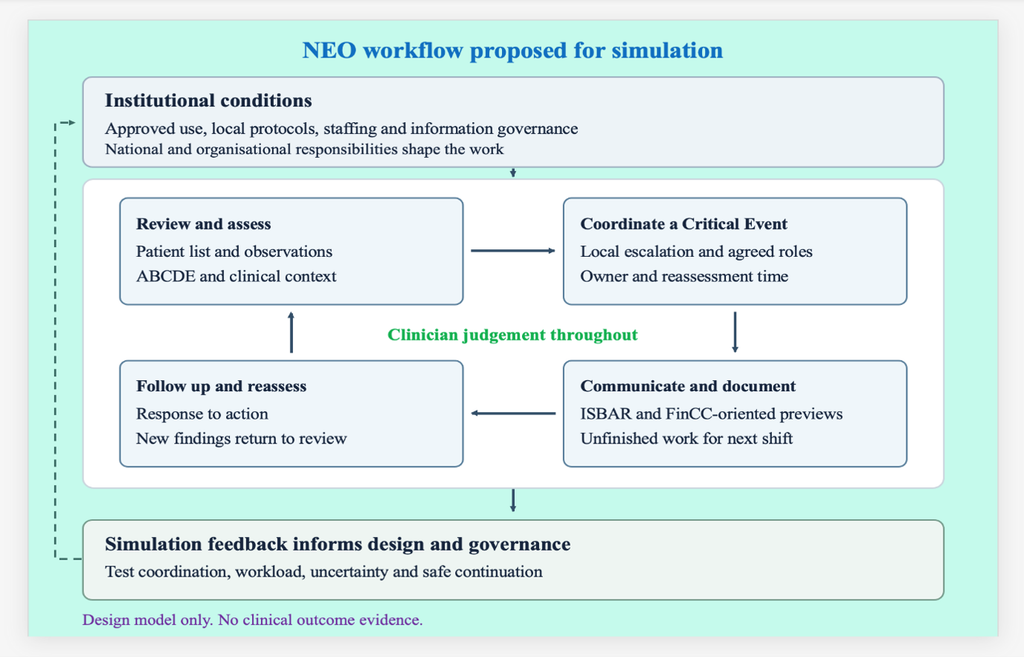
Figure 1. Proposed NEO workflow within institutional conditions. Arrows show intended connections, not verified implementation or clinical outcomes.
Consider a synthetic inpatient whose respiratory rate is rising while oxygen saturation is falling. NEO would first surface the time-stamped signals and their source, not declare a diagnosis. Next, the nurse would review the underlying observations and context, perform and record an ABCDE assessment, and use local escalation procedures. If the situation becomes a Critical Event, the workspace would support a concise ISBAR message, shared task ownership and visible reassessment time. Finally, a clinician-verified FinCC-oriented note and an EHR summary preview would then support continuity for the next professional or shift.
The important feature is not the number of screens. It is the closed loop from noticing to acting, communicating, documenting, checking and learning. The prototype does not place orders, contact services, write into a live EHR or make autonomous diagnostic or treatment decisions. All current cases and records are synthetic, and every proposed output remains advisory and subject to clinician verification.
Human Oversight and Ethical Safeguards
In the NEO design, AI is bounded assistance for organising signals, proposing priority and presenting a rationale. In practice, human oversight is meaningful only when a user can inspect source data and timestamps, understand limitations, reject or ignore a suggestion, record the final professional assessment and continue safely if the AI function is unavailable. WHO guidance similarly places autonomy, safety, transparency, accountability, equity and responsiveness at the centre of health AI (World Health Organization, 2021). The EU AI Act also makes intended purpose central to risk classification and emphasises effective human oversight for high-risk systems (Regulation (EU) 2024/1689, the AI Act, 2024). NEO has not been assigned a regulatory classification; that assessment must follow a frozen intended purpose and verified functionality.
Ethical design also requires attention to what the interface may silence. For instance, a clean summary can hide uncertainty, outdated data or missing observations. A priority list can disadvantage atypical cases. Repeated low-value alerts can teach users to ignore the system. For this reason, provenance, uncertainty, alert burden, accessibility, equitable use and safe fallback are evaluation requirements rather than future additions. At the present stage, these are design commitments, not proof that an AI model is safe or effective.
Clinical Workflow Validation Before Piloting
As of August 2026, NEO is a clickable proof of concept using synthetic cases. It has not undergone clinical validation, has not been deployed in care and has not used real patient data. The intended OuluHealth Lab pathway is awaiting confirmation from the relevant clinical experts and organisations; its starting date remains subject to agreement. The planned sequence begins with SIMLab feedback and simulation testing and, if the findings justify progression, continues to OYS TestLab feedback and end-user prototype testing.
Within this pathway, synthetic scenarios should examine more than whether participants like the interface. Relevant measures include prioritisation agreement; time from first signal to escalation; completeness of ABCDE assessment and ISBAR communication; consistency of FinCC-oriented documentation; rationale comprehension; appropriate overrides; alert burden; follow-up ownership; task completion; usability; workflow interruptions; data integrity; AI-related near misses; and the ability to continue safely during failure. To assess these outcomes, observation, task logs and interviews should be combined because complex technology programmes are shaped by interactions among the technology, users, organisation, value proposition and wider context (Greenhalgh et al., 2017). Beyond simulation, any later clinical pilot would require separate permissions, governance and evidence thresholds.
A university of applied sciences can provide a protected boundary between an attractive prototype and a clinical claim. In practice, simulation laboratories allow nurses, educators, human-factors specialists, engineers and health-service partners to expose assumptions before patients depend on them. The development record can connect each identified workflow risk to a design decision, test case, finding and revision. This creates practical RDI evidence even when the correct result is to remove a feature, narrow the intended purpose or pause progression.
Within this collaborative approach, nurse-led design matters because nursing work crosses observations, coordination, documentation, education and continuity. Yet nurse-led does not mean nurse-only. A credible system must be co-developed with end users, patients or patient representatives where appropriate, physicians, informatics and cybersecurity specialists, managers and governance experts. The goal is collective capability: each actor should see what they need, know who owns the next action and be able to challenge the technology. Systems intelligence concerns action within relationships that each participant also changes (Hämäläinen & Saarinen, 2008). Joint review can help the team recognise these effects and adjust its work together.
NEO proposes that clinical workflow intelligence should be judged by whether it helps people coordinate safe action across the whole care loop, not by whether an isolated model produces an impressive score. Its current contribution is a testable, human-centred design and an explicit evidence plan. If simulation reveals confusion, delay, excessive alerts or unsafe reliance, those findings will be as important as positive usability results. Ultimately, system intelligence in healthcare begins when technology makes relationships, responsibilities and uncertainty easier to navigate while clinicians remain in control.
Funding: Oamk proof-of-concept support for the first phase.
Carayon, P., Schoofs Hundt, A., Karsh, B.-T., Gurses, A. P., Alvarado, C. J., Smith, M., & Flatley Brennan, P. (2006). Work system design for patient safety: The SEIPS model. Quality & Safety in Health Care, 15 Suppl 1(Suppl 1), i50-58. https://doi.org/10.1136/qshc.2005.015842
Ghebrebrhan, T. (2026). Design and theoretical development of a nurse-led enhanced oncology nursing model in Finland: FinCC 4.0 alignment and nanoparticle-based therapy: an innovative concept – Oamk Journal. (2026, January 26). http://urn.fi/urn:nbn:fi-fe202601227536
Greenhalgh, T., Wherton, J., Papoutsi, C., Lynch, J., Hughes, G., A’Court, C., Hinder, S., Fahy, N., Procter, R., & Shaw, S. (2017). Beyond Adoption: A New Framework for Theorizing and Evaluating Nonadoption, Abandonment, and Challenges to the Scale-Up, Spread, and Sustainability of Health and Care Technologies. Journal of Medical Internet Research, 19(11), e8775. https://doi.org/10.2196/jmir.8775
Hämäläinen, R. P. (editor), & Saarinen, E. (editor). (2008). Systems Intelligence – A New Lens on Human Engagement and Action. Aalto University. https://aaltodoc.aalto.fi/handle/123456789/102719
Kinnunen, U.-M., Liljamo, P., Härkönen, M., Ukkola, T., Kuusisto, A., & Hassinen, T. (2025, March). The Finnish Care Classification System, FinCC 4.0 – User Guide: V. 1.4. Finnish Institute for Health and Welfare = Terveyden ja hyvinvoinnin laitos THL. https://www.julkari.fi/handle/10024/151228
Müller, M., Jürgens, J., Redaèlli, M., Klingberg, K., Hautz, W. E., & Stock, S. (2018). Impact of the communication and patient hand-off tool SBAR on patient safety: A systematic review. https://doi.org/10.1136/bmjopen-2018-022202
Nijor, S., Rallis, G., Lad, N., & Gokcen, E. (2022). Patient Safety Issues From Information Overload in Electronic Medical Records. Journal of Patient Safety, 18(6), e999–e1003. https://doi.org/10.1097/PTS.0000000000001002
Regulation (EU) 2024/1689 of the European Parliament and of the Council of 13 June 2024 Laying down Harmonised Rules on Artificial Intelligence and Amending Regulations (EC) No 300/2008, (EU) No 167/2013, (EU) No 168/2013, (EU) 2018/858, (EU) 2018/1139 and (EU) 2019/2144 and Directives 2014/90/EU, (EU) 2016/797 and (EU) 2020/1828 (Artificial Intelligence Act) (Text with EEA Relevance) (2024). http://data.europa.eu/eli/reg/2024/1689/oj
Sittig, D. F., & Singh, H. (2010). A new sociotechnical model for studying health information technology in complex adaptive healthcare systems. BMJ Quality & Safety, 19(Suppl 3), i68–i74. https://doi.org/10.1136/qshc.2010.042085
Sutton, R. T., Pincock, D., Baumgart, D. C., Sadowski, D. C., Fedorak, R. N., & Kroeker, K. I. (2020). An overview of clinical decision support systems: Benefits, risks, and strategies for success. NPJ Digital Medicine, 3, 17. https://doi.org/10.1038/s41746-020-0221-y
World Health Organization. (2021). Ethics and governance of artificial intelligence for health: WHO guidance. https://www.who.int/publications/i/item/9789240029200
NEO is a nurse-led clinical workflow intelligence prototype developed in Finland to address fragmented ongoing review and loss of shared situational awareness during acute deterioration. It is designed to help clinicians prioritise care according to risk triage, assess patients and coordinate responses to critical events, while supporting team communication and follow-up. Previews of structured nursing documentation (FinCC 4.0) and electronic health record (EHR) summaries are intended to support shared understanding and continuity across professionals and shifts. Artificial intelligence (AI) is framed as bounded assistance that surfaces signals and rationales; nurses retain clinical responsibility for interpretation, escalation and documentation. The prototype currently uses synthetic cases only and has not been clinically validated. A proposed OuluHealth Lab pathway would examine workflow fit, usability, safety, alert burden and safe fallback before any clinical pilot is considered.
When a patient is deteriorating, the problem is not about the absence of information. Rather it is about the observations, laboratory trends, earlier notes, handover messages and unfinished tasks are separated across time, screens and professional roles. For example, a nurse may recognise one signal, a physician another, while the incoming shift receives only part of the reasoning. In this setting, adding an AI score can create one more fragment unless the surrounding work is redesigned.
Against this background, I developed NEO as an independent, nurse-led clinical workflow intelligence prototype to explore this gap. NEO began as an oncology-oriented concept linking digital symptom monitoring, risk flags and FinCC 4.0 documentation (Ghebrebrhan, 2026). The current prototype covers a broader systems question: how could technology help a clinical team move coherently from fragmented signals to prioritisation, assessment, escalation, communication, documentation and follow-up? These steps are interdependent: information and responsibility pass between people, teams and shifts, so an omission can affect the whole care process. This article reports the design rationale and prospective evaluation plan. It does not report clinical outcomes.






Vastaa