

Kaisa Savolainen, DA, MSc (Tech), VoT, Senior specialist, Laurea UAS
Introduction
User (or stakeholder) participation and collaboration in design processes is recommended in e.g. service design, human-centered design and collaborative design. User involvement is also an essential part of systemic design (Salmi & Pöyry-Lassila, 2020; Design Council, n.d.). Additionally, systemic design is often connected to service design to enhance participation and user involvement (Suoheimo et al., 2025).
However, less attention has been paid to how and whom to involve when designing complex systems or pursuing systemic change. Today most of our systems and usage environments are complex, they consist of a combination of services and systems covering a broad variety of tasks. System-level complexity can arise from complexity in the context, tasks or systems (Saari et al., 2024). When systems are complex, they usually include numerous different types of users or other stakeholders working on different types of tasks with varying parts of the system in a diverse environment. Finding the right user groups to involve becomes difficult, as there are several different user groups and a broad number of users. Additionally, when designing for these systems, it becomes essential to consider the system as a whole, i.e. to look at the forest instead of single trees. As it is simpler to design for individual services, we often tend to optimize for the experiences of single products or services which can cause problems on the system level. Moreover, this becomes even more complex when starting to design for complex systemic changes; we often need to consider more-than-human actors as well, which cannot be involved in the design process similarly to human actors.
To support these situations when traditional user involvement becomes difficult, user representations can support the design work. User representations can be in various forms and from a variety of sources, the most known types being user personas and profiles (Cooper et al., 2014). But even in collaborative design events the participants are actually representing a broader user group.
This text will address, what are user representations and why are they important? How can they aid in Systemic Design. Additionally, this text will discuss how AI could support in representing users in complex environments and what are the implications for higher education.
It should be noted that the purpose of this article is not to question the value of direct user involvement or participation. Rather, it aims to offer complementary perspectives on how users can be considered when participation becomes difficult or impossible.
Representations
For the purposes of this article, the term user representations is used throughout, although the discussion applies equally to other stakeholders. Furthermore, the concept of a user may encompass a wide variety of actors. For instance, in, often complex, healthcare services, ‘the user’ can be the patient, the patient’s relative, the physician, nurse or other caregiver, the hospital management, IT personnel and so on. Thus, it becomes quite evident that ‘the users’ have quite differing needs, goals and skills.
In general, user representations can be from various sources and forms: (Hyysalo & Johnson, 2015; Savolainen & Hyysalo, 2021), being based on information such as research, documentation, regulatory demands etc. Hyysalo and Johnson (2015) present an overview of different sources of user representations for those interested. Most typical types of user representations are personas and user profiles (e.g. Cooper et al., 2014; Pruit & Grudin, 2003). However, there are additionally, e.g., different mappings and descriptions, such as empathy maps and scenarios (Gaziulusoy & Ryan, 2017) and oral discussions (Jensen & Thorsen, 2026). Representation can also happen in the form of workshop participation in e.g. co-design workshops or others alike. However, this format does not resolve the problem of broad and diverse user groups. Figure 1 presents an example of a persona and journey map (created by Microsoft 365 Copilot).
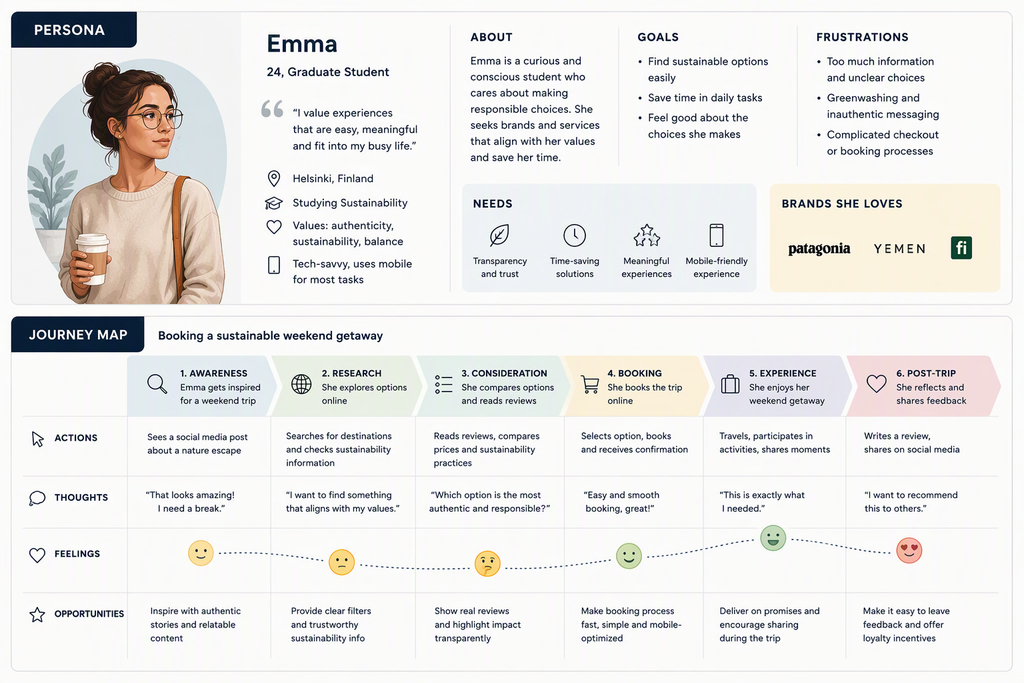
Figure 1. Example of a persona description and journey map. Visualization created by Microsoft 365 Copilot.
The main purpose of user representations is to transfer information of the users in the design process. It is not tied to any specific design phase as the example presented by (Jensen & Thorsen, 2026) demonstrates.
One challenge when designing for complex systemic changes is that the processes need to consider also other stakeholders than humans. More-than-human design is one way to address these settings and, as it is derived from human-centered design, also representing these more-than-human actors have been considered. One approach has been to extend the traditional representation methods to other actors, creating tools such as nonhuman persona, animal persona, and experience map (Su Demir & Coşkun, 2025). But there are also completely new representations, such as Dirty Nails to represent soil minerals and Stromatolive to represent stromatolites (Su Demir & Coşkun, 2025).
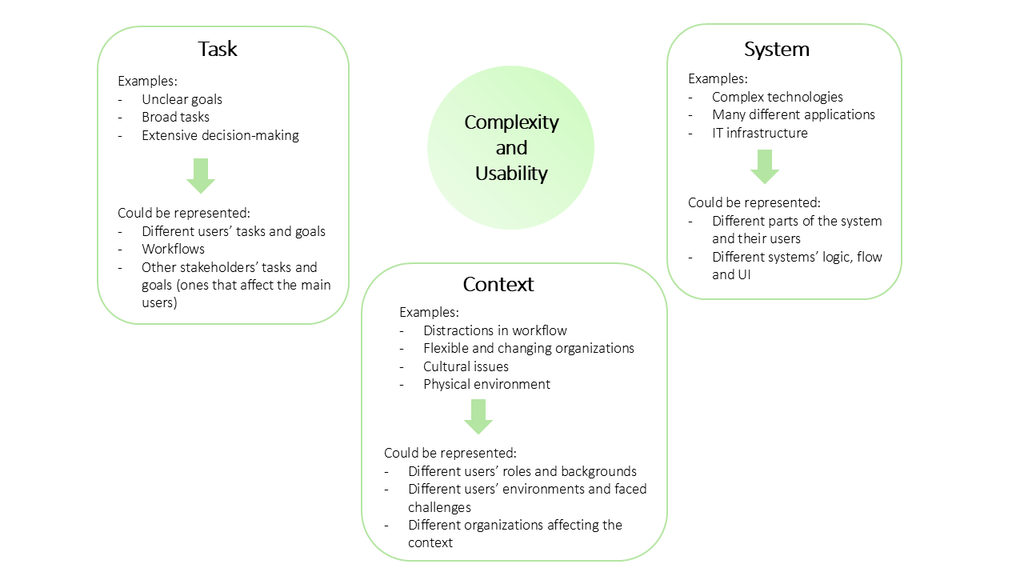
Returning to the topic of complex systems, it is useful to consider how complexity relates to representation. If complexity is caused by task, system and/or context (Saari et al., 2024), how do these link with representations. Firstly, we would need to represent all different user groups who are faced with the complexity of the system. Secondly, we would need to consider representations through the different aspects of complexity, which is representation beyond user representation and connects back to the different sources of representations. Saari et al. (2024) presents a figure describing the different aspects of complexity (or rather sources of complexity). Figure 2 has further developed their presentation and added ideas of what could be represented regarding each of the aspects. This is not presented as a fully developed or readily applicable model. Rather, it illustrates how issues of complexity and representation may be connected and how different forms of representation could support systemic design.
Figure 2. What out of task, system and context could be represented. Figure adapted from Saari et al. (2024)
AI in user representations
When considering the recent developments of AI and large language models, it is interesting to consider how AI could aid in user representations. There are already numerous examples of these. For example, AI can be utilized to form personas based on user data (Salminen et al., 2025). Additionally, conversational agents, based on actual user data, can be built to act as different user groups (Salminen et al., 2026). Despite these developments, several important questions remain open for future research: (1) How to ensure that AI does not come up with characteristics that are not based on the data or that it does not highlight something that should not be highlighted? (2) How can users’ behavior be represented with AI, or can it? (3) Is AI qualified ethically to represent non-human actors? (4) When considering specifically systemic design, how could AI support in representing the users? Is it only through more efficient handling of user data and providing representations or could it be used in more divers ways? Exploring these questions may provide valuable insights into the possibilities and limitations of supporting representations with AI.
Implications for higher education
Higher education institutions commonly teach service design, design thinking and research methods, often including connections to systemic design. We talk about participation and collaborative design methods and highlight the importance of user involvement; we might even talk about personas and user profiles or at least empathy maps and user journey maps. However, what often is not discussed is the concept of user representations and how the users are basically always represented. We could also describe in more detail the different sources of user representations, the diverse ways representations are used in real-life cases and what opportunities they could offer in systemic design. This would help the students to understand the concept of user involvement and (more-than) human-centeredness more broadly. This topic may sometimes be seen too theoretical. However, as some of the examples referred to in this article prove, it is very much linked to practice. As future professionals increasingly encounter complex service ecosystems and societal transformation challenges, a broader understanding of user representations may become an important component of design education.
Conclusion
User representations provide a valuable way to incorporate user perspectives into systemic design when direct participation is difficult. As systems become increasingly complex, understanding how different users and stakeholders can be represented may help students and professionals better navigate complexity and support systemic change.
Berre Su Demir, S., & Coşkun, A. (2025). Rethinking representation in design: Towards constructing parameters for representation tools in more-than-human design. In Proceedings of the 2025 ACM Designing Interactive Systems Conference (DIS ’25) (pp. 178–194). Association for Computing Machinery. https://doi.org/10.1145/3715336.3735680
Cooper, A., Reimann, R., Cronin, D., & Noessel, C. (2014). About face: The essentials of interaction design (4th ed., pp. 60–90). John Wiley & Sons.
Design Council (n.d.). Systemic Design Framework. https://www.designcouncil.org.uk/resources/systemic-design-framework/. [visited 7.7.2026]
Gaziulusoy, İ., & Ryan, C. (2017). Shifting conversations for sustainability transitions using participatory design visioning. The Design Journal, 20(sup1), S1916–S1926. https://doi.org/10.1080/14606925.2017.1352709
Hyysalo, S., & Johnson, M. (2015). The user as relational entity: Options that deeper insight into user representations opens for human-centered design. Information Technology & People, 28(1), 72–89.
Jensen, T. E., & Thorsen, A.-S. (2026). Rethinking iterative design: A case study of a design team’s handling of user representations. Designing, 2(1–2), 13–24.
Pruitt, J., & Grudin, J. (2003). Personas: Practice and theory. In Proceedings of the 2003 Conference on Designing for User Experiences (DUX ’03) (pp. 1–15). Association for Computing Machinery. https://doi.org/10.1145/997078.997089
Saari, T., Savolainen, K., Tyllinen, M., Viitanen, J., & Nieminen, M. (2024). Addressing usability and complexity in procurement of IT systems. Journal of User Experience, 20(1), 27–45.
Salmi, A., & Pöyry-Lassila, P. (2020). Systemic design addressing complexity in service ecosystems: Integrating empathic and systemic perspectives. In T. Hirvikoski, L. Erkkilä, M. Fred, A. Helariutta, I. Kurkela, P. Pöyry-Lassila, K. Saastamoinen, A. Salmi, & A. Äyväri (Eds.), Co-creating and orchestrating multistakeholder innovation. Laurea University of Applied Sciences.
Salminen, J., Amin, D., & Jansen, B. J. (2025). Using AI for user representation: An analysis of 83 persona prompts. In 2025 IEEE/ACS 22nd International Conference on Computer Systems and Applications (AICCSA) (pp. 1–8). IEEE. https://doi.org/10.1109/AICCSA66935.2025.11315350
Salminen, J., Jung, S.-G., Kaate, I., Xuan, T. T. T., Azem, J. Y., Aldous, K. K., Amin, D., & Jansen, B. J. (2026). AI representing personas representing user groups: Applying the agency theory to examine interaction challenges of conversational personas as decision-making tools. Decision Support Systems, 205, Article 114633. https://doi.org/10.1016/j.dss.2026.114633
Savolainen, K., & Hyysalo, S. (2021). User representations as a design resource: Representational work in achieving accountable design without access to users. Science & Technology Studies, 34(2), 25–45. https://doi.org/10.23987/sts.84598
Suoheimo, M., Jones, P., Lee, S.-H., & Sevaldson, B. (2025). Innovations in theory and practice of systemic service design. In M. Suoheimo, P. Jones, S.-H. Lee, & B. Sevaldson (Eds.), Systemic service design (1st ed.). Routledge. https://doi.org/10.4324/978100350103
Today most of our systems and usage environments are complex, they consist of a combination of services and systems. As it is simpler to design for individual services, we often tend to optimize the experiences of single products or services which causes challenges on the system level. Often, when considering the system level, there are numerous different user groups and a broad number of users, which makes it difficult to involve the relevant users. Similarly, involvement is difficult with future-oriented systems, or when considering more-than-human actors.
To support design in these complex settings, user representations can play a role. User representations can be in various forms and from a variety of sources.
This paper will address the following topics: what are user representations and why are they important? How can they aid in Systemic Design? How AI could support in representing users in complex environments and what are the implications for higher education.



Vastaa