Annikki Arola, Reg OT, PhD, Prinicpal lecturer, Arcada UAS
Ira Jeglinsky-Kankainen, Reg PT, Associated Professor, Prinicpal lecturer, Arcada UAS
Filip Levälahti, M.Ed., E-learning specialist, Arcada UAS
Camilla Wikström-Grotell, Reg PT, PhD, Vice Director Research, Arcada UAS
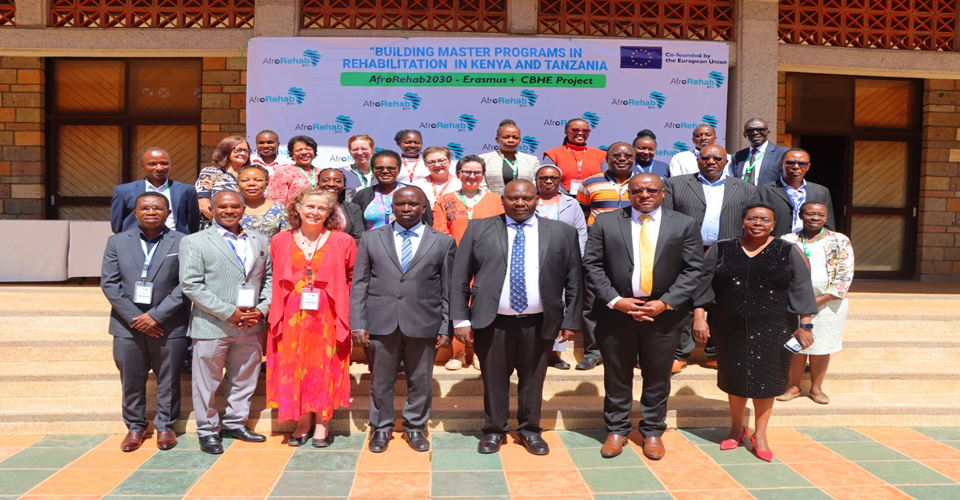
The AFROREHAB2030 project is grounded in the growing expectation that higher education institutions should actively contribute to the public good (Ilieva-Trichkova et.al. 2024). In many countries, the demand for qualified rehabilitation professionals is increasing due to demographic changes, the growing prevalence of non-communicable diseases, injuries, and the long-term consequences of illness. The project brings together four universities in Kenya and Tanzania, Arcada in Finland, and Høgskulen på Vestlandet (HVL) in Norway. Together, the partners are building a new master’s level program in rehabilitation that responds to pressing societal needs in East Africa.
To ensure the curriculum is relevant and grounded in real needs, Arcada actively supported the implementation of a needs analysis, which helped identify learner requirements, existing gaps, and stakeholder expectations. In curriculum development, Arcada’s contribution focuses on interprofessional collaboration and a holistic, user-centered approach, as the prevailing model has traditionally been medically oriented. The project also addresses how online and hybrid teaching solutions can be implemented despite the strong tradition of practical training within health care and rehabilitation education.
A collaborative approach to needs analysis
The development of rehabilitation programs in African contexts requires a comprehensive understanding of existing needs from multiple stakeholder perspectives, including employers, professionals, students, and community groups representing diverse populations of individuals with disabilities. To establish a realistic and contextually grounded basis for such educational programs, a systematic needs analysis was undertaken. A structured needs analysis enables the identification of competence gaps, labour market expectations, and contextual conditions that shape rehabilitation practices in the field (Kern, 2022). Through a collaborative approach to determining needs and designing the program, it becomes possible to ensure alignment with required professional standards. Moreover, this process ensures that the curriculum adequately prepares students for the challenges inherent in the context (Cuiccio & Husby-Slater, 2018),in this case, rehabilitation work in Africa. When curricular content is grounded in empirically identified and contextually relevant needs, it enhances students’ awareness, motivation, and engagement with their studies. Additionally, a needs analysis provides a solid foundation for subsequent program evaluation, thereby facilitating continuous development and ensuring that the curriculum remains aligned with evolving practices and emerging research within the field.
The practical implementation of the needs analysis involved the AfroRehab team identifying key stakeholder groups, specifically employers, professionals, and representatives of various groups of people with disabilities. For each stakeholder category, a tailored questionnaire was developed, comprising questions pertaining to aspects of the educational program deemed relevant to that group. The content of the questionnaires was discussed repeatedly within the team to ensure conceptual clarity, appropriate scope, and the avoidance of ambiguity.
The questionnaires were subsequently distributed to all identified stakeholders. Furthermore, focused stakeholder meetings were conducted in each participating country to enable deeper discussion, gather additional information, and elicit stakeholders’ perspectives through direct dialogue.
Analysis of the collected data revealed a strong emphasis on highlighting issues that may influence curriculum development, as a means of responding to the needs and expectations of those affected by the subject. Respondents linked this motivation to domains such as evidence-based practice, interdisciplinarity, leadership, and clinical excellence. Additionally, the findings underscored the significance of digital competence, defined as the ability to use various digital tools in diverse contexts and to integrate digital solutions effectively into professional practice. A key finding was the importance of fostering motivation for lifelong learning in a master’s level rehabilitation program in Africa.
Interprofessional curriculum development
The curricula development has been a dynamic and long process where representatives from all the universities have been involved. Arcada’s contribution focuses on interprofessional collaboration and a holistic, person-centered approach (Jesus et al, 2019), as the prevailing model has traditionally been medically oriented. During the curricula development there has been a comprehensive consultation process involving key stakeholders from education, clinical training environments, and professional networks.
The Master in Rehabilitation programme is designed to prepare rehabilitation professionals with advanced competencies to lead and develop the rehabilitation field. The programme should therefore equip students to serve as expert clinicians, educators, and consultants within multidisciplinary teams and in various rehabilitation fields. According to national principles in the involved African countries, the studies should encompass fieldwork and clinical practices. Fieldwork builds on bachelor‑level clinical foundations and provides opportunities to refine advanced assessment, clinical reasoning, evidence‑informed decision‑making, and leadership in complex rehabilitation contexts, including the use of innovative technologies and assistive devices. Digital competence, health technology as well as assistive technology needed to be an important part of the studies, driven not only by the fact that studies need to be blended, but also by rising rates of especially traffic injuries and chronic illness in the East African countries (The 2008 Tanzanian Disability Survey).
The curriculum is structured so that the first semester of the first academic year consists of shared studies in rehabilitation science. In the second semester, students begin their profession‑specific courses while continuing with selected common modules, such as community‑based health strategies, leadership, and educational strategies. During the second academic year, the focus shifts primarily to the profession-specific studies. The professional exits are: Occupational Therapy, Physiotherapy, Prosthetics and Orthotics, Speech and Language Therapy, Audiology, and Optometry. The framework encompasses competence domains covering knowledge, skills, and professional attitudes and the programme emphasizes person‑centred and interprofessional practice throughout all studies (Figure 1).
During the development of the curriculum, certain challenges emerged, sparking intensive discussions within this Nordic–African collaboration. In the African partner countries, the prevailing medical tradition initially made a person‑centered approach feel challenging. At the beginning of the collaboration, there were also strong professional boundaries between the different disciplines, which made the interprofessional orientation of the programme difficult to implement. Over the course of the project, however, many of these challenges have been addressed. We can now, for example, observe a clear interprofessional approach throughout the curricula, despite the presence of profession‑specific exits. There is also a requirement that the leads for each profession‑specific component must hold a doctoral degree. Consequently, several of the African lecturers involved have begun doctoral studies during the project period.
 Figure 1. Schematic figure of the planned curricula for Master in Rehabilitation Science.
From traditional to blended learning
The project also addresses how online and hybrid teaching solutions can be implemented despite the strong tradition of practical training within health care and rehabilitation education.
The development of learning platforms and digital technology has opened new opportunities for innovative pedagogy in online and blended education. This creates unique possibilities, including reaching new target groups and offering more flexible learning opportunities. In the case of African countries (south of the Sahara), there are still major challenges such as insufficient infrastructure, economic constraints, and limited digital competence (Arpit 2025, Oladosu 2026). At the same time, digital development continues to accelerate. For instance, in 2025 about 30% of Tanzania’s population had internet access, representing a 2.9 percentage point increase from the previous year (DataReportal, 2026).
Online education, when well designed, can be at least as effective as face‑to‑face teaching, while also providing greater flexibility and reaching new groups of learners. Blended learning also offers certain advantages compared to face‑to‑face instruction (Bates 2019, Arpit 2025). Combining the strengths of different forms of teaching can give students a solid foundation and deepen learning in a more flexible way. This flexibility is strongly supported by user‑friendliness and access to relevant materials, which enables students to learn independent of time, place, or pace (Habibi 2023, Arpit 2025). It also supports the learning of theoretical content, which gives blended learning an advantage, as practical exercises can be prioritized during in‑person sessions.
Higher education as a driver of societal change
Nordic collaboration forms an important foundation for the project. Arcada and HVL bring experience from the Nordic welfare model, where rehabilitation is closely connected to inclusion, participation, and equality. By sharing knowledge, pedagogical approaches, and research traditions, the Nordic partners contribute to building sustainable academic environments in Kenya and Tanzania.
In the long term, the social impact of the project extends beyond the educational institutions themselves. Strengthened master’s education in rehabilitation can support policy development, improve service delivery, and contribute to research that addresses regional health challenges. Ultimately, the project aims to empower professionals, institutions, and communities to promote health, participation, and well-being for people who need rehabilitation services.
Through this collaboration, higher education becomes a driver of social change, building knowledge, fostering holistic and person-centered rehabilitation services and contributing to more inclusive societies.
Arpit Jain. (2025). A Comparative Study of Online vs. Traditional Learning in Higher Education.
International Journal for Research in Education (IJRE), 14(1). https://doi.org/https://doi.org/10.63345/ijre.v14.i1.2
Bates, A. W. (2019). Teaching in a Digital Age. Guidelines for designing teaching and learning (2nd ed.). Tony Bates Associates Ltd. https://pressbooks.bccampus.ca/teachinginadigitalagev2/
Cuiccio, C., & Husby-Slater, M. (2018). Needs assessment guidebook: Supporting the development of district and school needs assessments. Accessed: 2026-03-11 from: https://www.ed.gov/teaching-and-administration/lead-and-manage-my-school/state-support-network/ssn-resources/needs-assessment-guidebook
DataReportal. (10 March 2026). Digital 2026: Tanzania. DataReportal. https://datareportal.com/reports/digital-2026-tanzania
Habib, N., Danica, S., & Nadia, H. (2023). South African health sciences students’ perspectives on utilisation, constraints and future possibilities of mHealth and e-Learning. Discover Education, 2(1). https://doi.org/10.1007/s44217-023-00045-y
Ilieva-Trichkova, P., Boyadjieva, P., & Dimitrova, R. (2024). Higher education as a public good and social cohesion: an exploratory study from a European comparative perspective. European Journal of Higher Education, 14(sup1), 69–87. https://doi.org/10.1080/21568235.2024.2403605
Jesus, T. S., Bright, F. A., Pinho, C. S., Papadimitriou, C., Kayes, N. M., & Cott, C. A. (2021). Scoping review of the person-centered literature in adult physical rehabilitation. Disability and rehabilitation, 43(11), 1626-1636.
Kern, D. (2022). Overview. A Six-Step Approach to Curriculum Development. In: Thomas, P., Kern, D., Hughes, M., Tackett, S., & Chen, B. Curriculum Development for Medical Education: A Six-Step Approach. 4th. ed. Baltimore: John Hopkins University Press
Oladosu, M.A. et al. 2026. Exploring Digital Health Innovations Across Africa: Challenges, Opportunities and the Way Forward. Journal of Health Informatics in Africa. 12, 2 (Jan. 2026), 47–68. DOI: https://doi.org/10.12856/JHIA-2025-v12-i2-612.
The 2008 Tanzanian Disability Survey. Available at: Tanzania, United Republic of – Disability Survey 2008 (March 3rd 2026).
This article describes the role of Arcada University of Applied Sciences in an Erasmus+ Capacity Building project AfroRehab2030. The societal goal is to address the growing need for advanced rehabilitation education and competence at four universities in East Africa. Arcada contributes expertise in rehabilitation, master’s programme development and online pedagogy, while emphasising equal partnership, local relevance, and sustainability. By developing a high-quality master’s program, the project supports the strengthening of local professional competence, research capacity, and evidence-based rehabilitation and thereby access to and quality of rehabilitation services.